Ego is an impediment for a leader, wise man, merchant or a servant, but it is a necessity for a warrior, a competitor.
A warrior is one who takes on challenges and commitment and stands by it.
Ego makes one sacrifice oneself for a cause. Ego gives strength and courage, brings valour to meet the challenges with endurance and perseverance. A strong ego will counteract depression. Often ego is thought to be selfish but it is the greatest motivating factor for creativity and generosity.
Ego propels one to venture into the unknown.
There are 3 types of ego - Sattvic, Rajasic and Tamasic.
Tamasic ego is barbaric and blind, and has self-destructive tendencies.
Rajasic ego is self-centered and causes misery to oneself and others.
Sattvic ego is creative and has protective tendencies.
If you cannot surrender, at least have a Sattvic ego, as a Sattivic ego is always ready to sacrifice.
People who are free, regret that they don't have discipline. They keep promising that they will become disciplined. People who are disciplined look for the end. (Discipline is not an end in itself, it is a means.)
Look at the people who have no discipline; they are miserable. Freedom without discipline is absolute misery. Discipline without freedom is suffocating.
Orderliness is monotonous and chaos is stressful.
We have to make the discipline free and the freedom disciplined.
People who are in company all the time, they look for the comforts of solitude. People who are in solitude, feel so lonely and want to be in company.
People who are in a cold place want to be in a warm place. People who are in a warm place love something cool.
This is the dilemma of life: Everyone is looking for perfect balance. Perfect balance is like a razor's edge. It can only be found in the self.
There is no road to this town and there are no steps to this house.
A person who argues should not be given knowledge. An argumentative mind is not receptive to knowledge. When someone is in an argumentative mood, then giving knowledge or advice is in vain.
In an argumentative mood you feel you know it all.
Then you are not ready for knowledge. That is why wise people do not give advice when they are in an argumentative environment.
The argument has a purpose. It can bring out the truth if there is no emotion or sense of "I" attached to it.
An argument can also have a disadvantage. It can make untruth appear to be truth.
A wise man will not take arguments seriously; he will just have fun with them.
Q: If every wish gets fulfilled at a particular time as per the will of God, what is the necessity of prayer?
Bhartiya Cultural ANSWER:
Well, prayer is not something that you impose on yourself or anyone else. Prayer is a natural call for help, or a natural expression of gratefulness. Prayer can happen only on two occasions: 1. When you are desperately in need of something then you pray. When you realize that you are weak and you cannot handle something, that is when you ask for help and that is a prayer. 2. When you realize that you have received more than what you really deserve, and it has all come to you as a blessing and as a gift, then the gratefulness that you express becomes a prayer. And if you extend this a little further, another occasion when prayer rises from within you is when you are in deep love with the maker of the universe or the divinity, in whatever form or formless way you perceive it to be. That is devotion.
So prayer it is something which happens spontaneously. And it's good to have a few rituals associated with prayer as it adds some colors to life. When you pray in a particular manner by lighting a candle or something that brings up to the surface those emotions that are sleeping in you. The benefits of prayer are: 1. It invokes those emotions that are sleeping within you. 2. It takes away the worry and burden in your head. 3. It builds confidence in you and you feel the connection from your side. You are already connected to the divine, but from your side you start realizing your connection to the higher power. 4. It puts you into routine. Suppose you make it a habit of praying every day, maybe the first four days go without any experience, but on the fifth day, you experience something. It's almost like any other sadhana. So make prayer a practice in your life so that you know you have something to do that is it ethereal.
Prayer is the way to connect to the something that is not so tangible but is existing. So, prayer could be one such link to the unknown and unseen. Falling in love with the unknown is faith.<
मैंने पूछा-
मौलाना साहब, जन्नत में कौन जायेंगे?
मौलाना - मुसलमान I
जी, कौन मुसलमान? शिया या सुन्नी.?
मौलाना - बेशक सुन्नी जनाब।
जी सुन्नी में कौन.? मुकल्लिद या गैर-मुकल्लिद.?
मौलाना- मुकल्लिद !
जी, मुकल्लिद में तो चार हैं। उनमें से.?
मौलाना - हनफी , और कौन.?
जी, पर हनफी में तो देबबंदी और बरेलवी दोनों हैं फिर उनमें..
मौलाना - देबबंदी I
बहुत शुक्रिया, पर देबबंदी में भी तो हयाती और ममाती दोनों हैं, उनमें से कौन.?
इसके बाद मौलानासाहब गायब हो गये ,वो दोबारा दिखे ही नहीं...!!
Here is a beautiful article from New York Times.While many of our own papers and tv channels deplore India, here is a view from
THE INDIAN ELECTIONS - NEW YORK TIMES
It is truly the greatest show on Earth, an ode to a diverse & democratic ethos, where 700 million + of humanity vote, providing their small part in directing their ancient civilization into the future.
It is no less impressive when done in a neighborhood which includes de-stabilizing & violent Pakistan, China, and Burma.
It's challenges are immense, more so probably than anywhere else, particularly in development & fending off terrorism -- but considering these challenges & its neighbors, it is even more astounding that the most diverse nation on Earth, with hundreds of languages, all religions & cultures, is not only surviving, but thriving.
The nation:
where Hinduism, Buddhism, Jainism & Sikhism were born,
which is the second largest Muslim nation on Earth;
where Christianity has existed for 2000 years;
where the oldest Jewish synagogues & Jewish communities have resided since the Romans burnt their 2nd temple;
where the Dalai Lama & the Tibetan government in exile reside;
where the Zoroastrians from Persia have thrived since being thrown out of their ancient homeland;
where Armenians, Syrians & many others have come to live; where the Paris-based OECD said was the largest economy on Earth for 1500 of the last 2000 years, including the 2nd largest, only 200 years ago;
where 3 Muslim Presidents have been elected,
where a Sikh was Prime Minister & the head of the ruling party a Catholic Italian woman,
where the past President was also a woman, succeeding a Muslim President who as a rocket scientist is a hero in the nation;
where a booming economy is lifting 40 million out of poverty each year & is expected to have the majority of its population in the middle class already, equal to the entire US population, by 2025;
where its optimism & vibrancy is manifested in its movies, arts, economic growth & voting, despite all the incredible challenges & hardships;
where all the great powers are vying for influence, as it itself finds its place in the world.
Where all of this is happening, is India and as greater than 1/10th of humanity gets ready to vote, it is an inspiration to the entire World.
Ratan Tata Tweet...
Germany is a highly industrialized country. In such a country, many will think its people lead a luxurious life.
When we arrived at Hamburg , my colleagues walked into the restaurant, we noticed that a lot of tables were empty. There was a table where a young couple was having their meal. There were only two dishes and two cans of beer on the table. I wondered if such simple meal could be romantic, and whether the girl will leave this stingy guy.
There were a few old ladies on another table. When a dish is served, the waiter would distribute the food for them, and they would finish every bit of the food on their plates.
As we were hungry, our local colleague ordered more food for us.When we left, there was still about one third of un-consumed food on the table.
When we were leaving the restaurant, the old ladies spoke to us in English, we understood that they were unhappy about us wasting so much food.
"We paid for our food, it is none of your business how much food we left behind," my colleague told the old ladies. The old ladies were furious. One of them immediately took her hand phone out and made a call to someone. After a while, a man in uniform from Social Security organisation arrived. Upon knowing what the dispute was, he issued us a 50 Euro fine. We all kept quiet.
The officer told us in a stern voice, "ORDER WHAT YOU CAN CONSUME, MONEY IS YOURS BUT RESOURCES BELONG TO THE SOCIETY. THERE ARE MANY OTHERS IN THE WORLD WHO ARE FACING SHORTAGE OF RESOURCES. YOU HAVE NO REASON TO WASTE RESOURCES."
The mindset of people of this rich country put all of us to shame. WE REALLY NEED TO REFLECT ON THIS. We are from country which is not very rich in resources. To save face, we order large quantity and also waste food when we give others a treat.
(Courtesy: A friend who is now changed a lot)
THE LESSON IS:- THINK SERIOUSLY ABOUT CHANGING OUR BAD HABITS. Expecting acknowledgment, that u read the message and forward to your contacts.
VERY TRUE -"MONEY IS YOURS BUT RESOURCES BELONG TO THE SOCIETY."
नाभी कुदरत की एक अद्भुत देन है
एक 62 वर्ष के बुजुर्ग को अचानक बांई आँख से कम दिखना शुरू हो गया। खासकर रात को नजर न के बराबर होने लगी।जाँच करने से यह निष्कर्ष निकला कि उनकी आँखे ठीक है परंतु बांई आँख की रक्त नलीयाँ सूख रही है। रिपोर्ट में यह सामने आया कि अब वो जीवन भर देख नहीं पायेंगे।.... मित्रो यह सम्भव नहीं है..
मित्रों हमारा शरीर परमात्मा की अद्भुत देन है...गर्भ की उत्पत्ति नाभी के पीछे होती है और उसको माता के साथ जुडी हुई नाडी से पोषण मिलता है और इसलिए मृत्यु के तीन घंटे तक नाभी गर्म रहती है।
गर्भधारण के नौ महीनों अर्थात 270 दिन बाद एक सम्पूर्ण बाल स्वरूप बनता है। नाभी के द्वारा सभी नसों का जुडाव गर्भ के साथ होता है। इसलिए नाभी एक अद्भुत भाग है।
नाभी के पीछे की ओर पेचूटी या navel button होता है।जिसमें 72000 से भी अधिक रक्त धमनियां स्थित होती है
नाभी में गाय का शुध्द घी या तेल लगाने से बहुत सारी शारीरिक दुर्बलता का उपाय हो सकता है।
1. आँखों का शुष्क हो जाना, नजर कमजोर हो जाना, चमकदार त्वचा और बालों के लिये उपाय...
सोने से पहले 3 से 7 बूँदें शुध्द घी और नारियल के तेल नाभी में डालें और नाभी के आसपास डेढ ईंच गोलाई में फैला देवें।
2. घुटने के दर्द में उपाय
सोने से पहले तीन से सात बूंद अरंडी का तेल नाभी में डालें और उसके आसपास डेढ ईंच में फैला देवें।
3. शरीर में कमपन्न तथा जोड़ोँ में दर्द और शुष्क त्वचा के लिए उपाय :-
रात को सोने से पहले तीन से सात बूंद राई या सरसों कि तेल नाभी में डालें और उसके चारों ओर डेढ ईंच में फैला देवें।
4. मुँह और गाल पर होने वाले पिम्पल के लिए उपाय:-
नीम का तेल तीन से सात बूंद नाभी में उपरोक्त तरीके से डालें।
नाभी में तेल डालने का कारण
हमारी नाभी को मालूम रहता है कि हमारी कौनसी रक्तवाहिनी सूख रही है,इसलिए वो उसी धमनी में तेल का प्रवाह कर देती है।
जब बालक छोटा होता है और उसका पेट दुखता है तब हम हिंग और पानी या तैल का मिश्रण उसके पेट और नाभी के आसपास लगाते थे और उसका दर्द तुरंत गायब हो जाता था।बस यही काम है तेल का।
अपने स्नेहीजनों, मित्रों और परिजनों में इस नाभी में तेल और घी डालने के उपयोग और फायदों को शेयर करिये।
करने से होता है , केवल पढ़ने से नहीं
Sophia Loren was a glamorous Hollywood star when I was growing up. She was entertaining but I wouldn’t have bet that I would learn any life-lessons from her. I hadn’t read this before & I have to admit, there’s much to learn from her story
God was moved by his prayers and told him to make ONLY ONE request which would be granted to him.
The man said, "God, I want my mother to see my wife putting diamond bangles on my daughter's wrists inside my Mercedes parked in front of my mansion when I'm watching them *over a drink of Blue Label."*
Life is too short but feels pretty long, There’s too much to do and so much going wrong, Most of the time you struggle to be strong, So before it’s too late and it’s time to go,
Sip your whiskey nice and slow.
Some friends stay, others go away, Loved ones are cherished, but not all will stay, Kids will grow up and fly away, No one really knows how things will go,
एक ऐसा दिमाग जो भविष्य को अनुभव करता हैं जो समाज के उत्थान और पतन दोनों का द्योतक हैं। ब्राह्मण ने समाज के सभी जातियों को एक दूसरे से पिरोया हैं
*ब्राह्मणों ने समाज को तोड़ा नहीं अपितु जोडा है..!
ब्राम्हणों ने विवाह के समय समाज के सबसे निचले पायदान पर खड़े
"दलित "को जोड़ते हुये अनिवार्य किया कि *दलित* स्त्री द्वारा बनाये गये चुल्हे पर ही सभी शुभाशुभ कार्य होगें..!
इस तरह सबसे पहले *दलित* को जोडा गया .....
धोबन के द्वारा दिये गये जल से ही कन्या सुहागन रहेगी इस तरह धोबी को जोड़ा...
कुम्हार द्वारा दिये गये मिट्टी के कलश पर ही देवताओ के पूजन होगें यह कहते हुये कुम्हार को जोड़ा...
मुसहर जाति जो वृक्ष के पत्तों से पत्तल/दोनिया बनाते है यह कहते हुये जोड़ा कि इन्हीं के बनाए गये पत्तल/दोनियों से देवताओं का पूजन सम्पन्न होगे...
कहार जो जल भरते थे यह कहते हुए जोड़ा कि इन्हीं के द्वारा दिये गये जल से देवताओं के पूजन होगें...
बिश्वकर्मा जो लकड़ी के कार्य करते थे यह कहते हुये जोड़ा कि इनके द्वारा बनाये गये आसन/चौकी पर ही बैठकर वर-वधू देवताओं का पूजन करेंगे ...
फिर वह हिन्दु जो किन्हीं कारणों से मुसलमान बन गये थे उन्हें जोड़ते हुये कहा गया कि इनके द्वारा सिले हुये वस्त्रों (जामे-जोड़े) को ही पहनकर विवाह सम्पन्न होगें...
फिर उस हिन्दु से मुस्लिम बनीं औरतों को यह कहते हुये जोड़ा गया कि इनके द्वारा पहनाई गयी चूडियाँ ही बधू को सौभाग्यवती बनायेगी...
धरिकार जो डाल और मौरी को दुल्हे के सर पर रख कर द्वारचार कराया जाता है,को यह कहते हुये जोड़ा गया कि इनके द्वारा बनाये गये उपहारों के बिना देवताओं का आशीर्वाद नहीं मिल सकता.... डोम जो गंदगी साफ और मैला ढोने का काम किया करते थे उन्हें यह कहकर जोड़ा गया कि *मरणोंपरांत* इनके द्वारा ही प्रथम मुखाग्नि दिया जायेगा....
👉इस तरह समाज के सभी वर्ग जब आते थे तो घर की महिलायें मंगल गीत का गायन करते हुये उनका स्वागत करती थीं...
और पुरस्कार सहित दक्षिणा देकर बिदा करती थी...,
ब्राह्मणों का दोष कहाँ है..?...हाँ ब्राह्मणों का दोष है कि इन्होंने अपने ऊपर लगाये गये निराधार आरोपों का कभी खंडन नहीं किया, जो ब्राह्मणों के अपमान का कारण बन गया..! इस तरह जब समाज के हर वर्ग की उपस्थिति हो जाने के बाद ब्राह्मण नाई से पूछता था कि क्या सभी वर्गो की उपस्थिति हो गयी है...?
*नाई* के हाँ कहने के बाद ही ब्राह्मण मंगल-पाठ प्रारम्भ किया करते हैं..!
ब्राह्मणों द्वारा जोड़ने की क्रिया को छोड़वाया कुछ ब्राह्मण विरोधी लोगों ने और दोष ब्राह्मणों पर लगा दिया..!
ब्राह्मणों को यदि अपना खोया हुआ वह सम्मान प्राप्त करना है तो इन बेकार वक्ताओं के वक्तव्यों का कड़ा विरोध कर रोक लगानी होगी।......
देश में फैले हुये समाज विरोधी साधुओं और ब्राह्मण विरोधी ताकतों का विरोध करना होगा जो अपनी अज्ञानता को छिपाने के लिये *वेद और ब्राह्मण* कि निन्दा करतेे हुये पूर्ण भौतिकता का आनन्द ले रहे हैं.....!
याद रखो ब्राह्मण वो पण्डे नहीं जो मंदिर को दुकान बनाते हैं, ये ज्ञान के भण्डार हैं जिनसे इस श्रृष्टि की रचना हुई....!
इस पोस्ट का मेरे *ब्राह्मण* होने या मनुवादी का सरोकार नहीं है..!
मेरा उद्देश्य अपनी पुरातन संस्कृति के अच्छे स्वरूप और सही अवधारणा के प्रस्तुतिकरण भर है ।
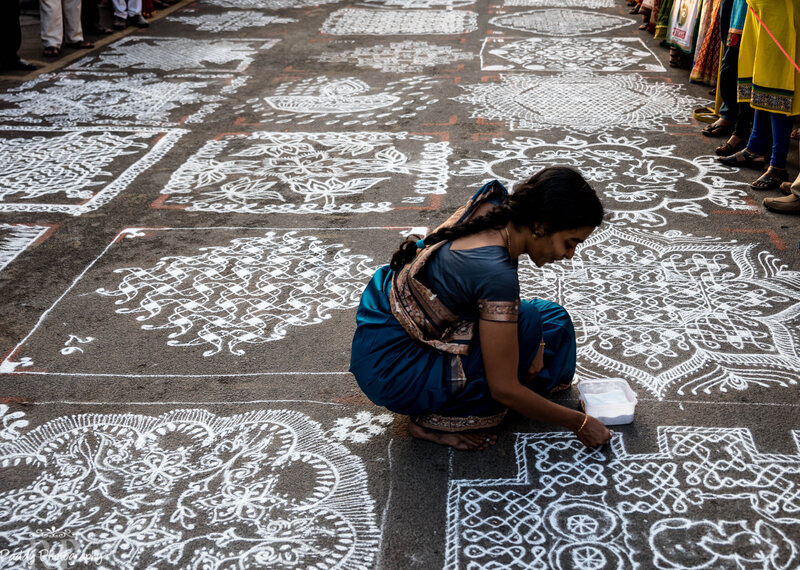
Kōlam festivals are one of the few remaining opportunities to showcase this slowly fading tradition. PADDY PHOTOGRAPHY/GETTY IMAGES
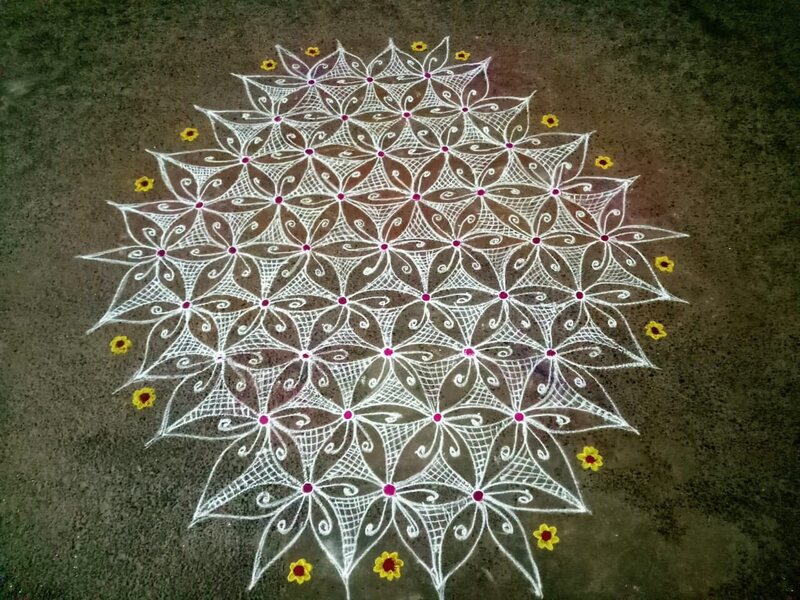
BEFORE THE FIRST RAYS OF sunlight stream across the rice fields and mud roads in the Nilgiri Mountains, before they force their way through the high-rises in the urban jungle of Chennai and Madurai, the women of Tamil Nadu are up for the day. In the dark, they clean the threshold to their home, and, following a centuries-long tradition, painstakingly draw beautiful, ritualistic designs called kōlam, using rice flour.
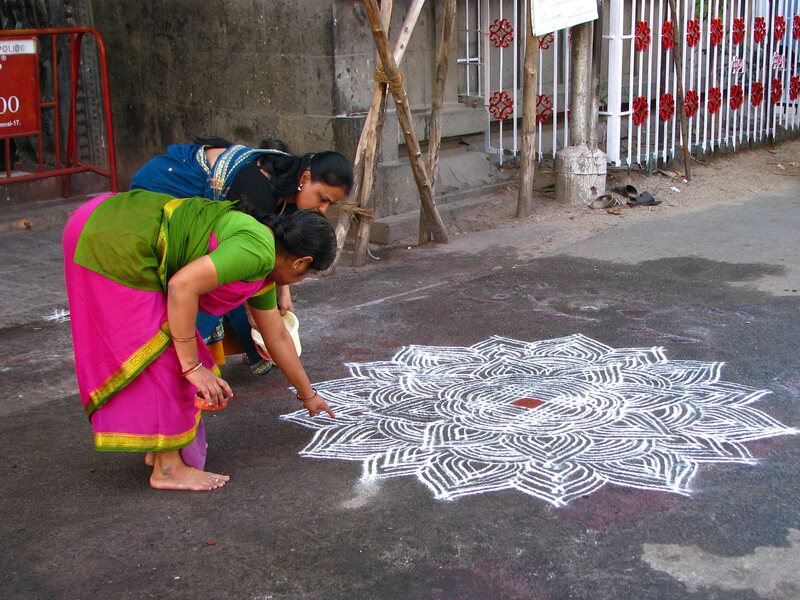
Taking a clump of rice flour in a bowl (or a coconut shell), the kōlam artist steps onto her freshly washed canvas: the ground at the entrance of her house, or any patch of floor marking an entrypoint. Working swiftly, she takes pinches of rice flour and draws geometric patterns: curved lines, labyrinthine loops around red or white dots, hexagonal fractals, or floral patterns resembling the lotus, a symbol of the goddess of prosperity, Lakshmi, for whom the kōlam is drawn as a prayer in illustration. The making of the kōlam itself is a performance of supplication. The artist folds her body in half, bending at the waist, stooping to the ground as she fills out her patterns. Many kōlam artists see the kōlam as an offering to the earth goddess, Bhūdevi, as well.
But the kōlam is not just a prayer; it is also a metaphor for coexistence with nature. In her 2018 book, Feeding a Thousand Souls: Women, Ritual and Ecology in India, an Exploration of the Kōlam, Vijaya Nagarajan, a professor in the Department of Theology and Religious Studies at the University of San Francisco, refers to the belief in Hindu mythology that Hindus have a “karmic obligation” to “feed a thousand souls,” or offer food to those that live among us. By providing a meal of rice flour to bugs, ants, birds, and insects, she writes, the Hindu householder begins the day with “a ritual of generosity,” with a dual offering to divinity and to nature.
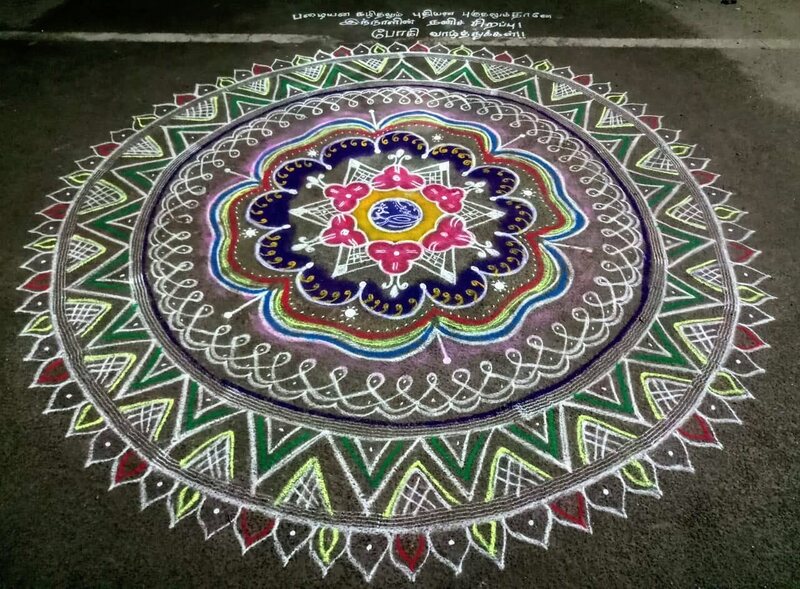
Colorful kōlams, such as this one by Godavari Krishnamurthy, are drawn during festivals. R. KRISHNAMURTHY/COURTESY OF KAVERI PURANDHAR
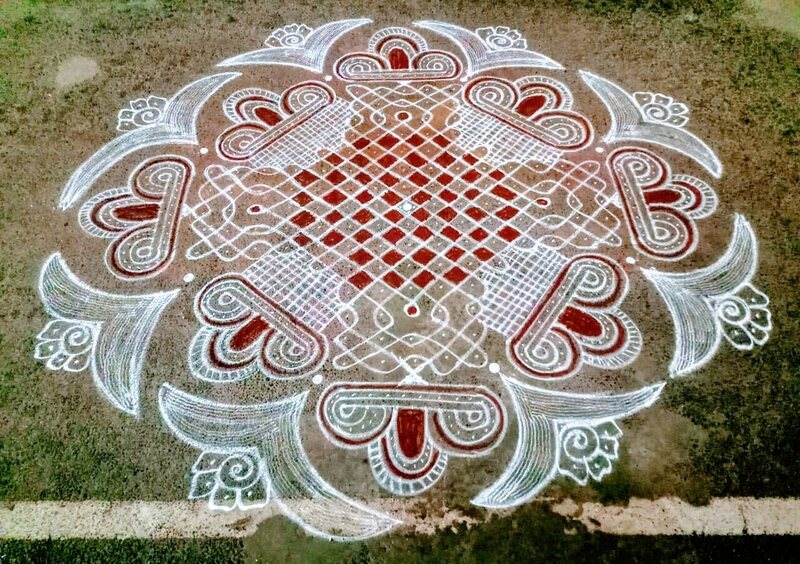
The word kōlam means beauty. What it also embodies is a perfect symmetry of straight or curved lines built around or through a grid of dots. Nearly always, the grid of dots comes first, requiring spatial precision to achieve symmetry. The dot in Hindu philosophy represents the point at which creation begins—it is a symbol of the cosmos. No tools other than the maker’s deft fingers, and the rice flour, are used. Sometimes the designs are one continuous line that loops over itself, snaking to infinity. Intersecting into infinite figure eights, in a style known as pulli kōlam, the kōlam is also believed to be a representation of infinity, of the infinite cycle of birth and rebirth that forms a foundational concept in Hindu mythology.
Mathematicians and computer scientists have keenly studied the kōlam. The kōlam is “an unusual example of the expression of mathematical ideas in a cultural setting,” writes Marcia Ascher, a professor emerita of Mathematics at Ithaca College. Citing her ethnomathematical research (a field of study combining anthropology and mathematics), Nagarajan adds that “The kōlam is one of the few embedded indigenous traditions that have contributed to the western mathematical tradition.”
While the kōlam-makers themselves may not be thinking in terms of mathematical theorems, many kōlam designs have a recursive nature—they start out small, but can be built out by continuing to enlarge the same subpattern, creating a complex overall design. This has fascinated mathematicians, because the patterns elucidate fundamental mathematical principles. Nagarajan writes about how the symmetry of kōlam art, such as the recurring fractals in the design, have been likened to mathematical models such as the Sierpinski triangle, a fractal of recursive equilateral triangles.
Woman have been teaching each other these traditional designs for centuries. MCKAY SAVAGE/CC BY 2.0
Computer scientists have also used kōlams to teach computers language fundamentals. Kōlam designs can be studied as a picture language. Quoting Ascher, Nagarajan notes that “akin to natural languages and computer languages, picture languages are made up of restricted sets of basic units and specific, formal rules for putting the units together.” Teaching the computer to draw kōlams gave computer scientists insight into how picture languages function, which they then used to create new languages. “It’s actually helping computer scientists understand something elemental about their own work,” said Nagarajan, in a presentation on the geometry of kōlam.
Despite the deep mathematical principles exhibited in kōlam designs, practitioners describe the process as intuitive and enjoyable. “It’s easy, especially once you start with a proper grid of dots,” says Godavari Krishnamurthy, who lives in Chennai and has been making kōlams for more than half a century. Krishnamurthy speaks to me over the phone as her daughter-in-law, Kaveri Purandhar, who lives in Ahmedabad, translates.
Today, the tradition of making kōlam is wrestling with time, short attention spans, and porch-less apartment living. It is grappling with changing affiliations to divinity, and changing displays of community among women. Kōlam competitions during festivals are now one of the few opportunities to showcase this artistic ritual. Although fewer Tamils are making the kōlam today, the competitions allow for more inclusivity, welcoming all who are interested to participate in this traditionally Hindu ritual.
The placement of the dots determines the perfect symmetry of the kōlam. R. KRISHNAMURTHY/COURTESY OF KAVERI PURANDHAR
During the festival month of Margazhi on the Tamil calendar, which falls between December and January, Krishnamurthy takes to the street in front of her Chennai home, drawing elaborate kōlams on the main thoroughfare, defiantly taking up the road and stooping low for hours. There is almost an urgency to her work, her need to preserve a disappearing tradition, even as passing cars cover her in the dust of a city pulsating with modernity, with little space for such painstaking, back-breaking pursuits. “It’s a great exercise in concentration,” she says, via Purandhar, “and good for health and for nurturing one’s creativity.”
Krishnamurthy learned from her mother, and mothers have been teaching daughters for centuries. “The kōlam is a powerful vehicle for Tamil women’s self-expression, a central metaphor and symbol for creativity,” writes Nagarajan. “It evokes an entire way of being in the world; it articulates desires, concerns, sensibilities, and suffering, and ultimately it affirms the power of women’s blessings to create a desired reality: a healthy, happy household.” Although some men make kōlams, it is historically the domain of women.
Krishnamurthy’s immediate family offers wholehearted support, but little inclination to participate. She gives copies of her designs to anyone who shows interest. Little design books for kōlam have been around since at least 1884, writes Nagarajan. Skilled kōlam makers will maintain a ledger of their own designs that becomes a family heirloom.
Kōlam designs reflect mathematical principles, such as fractals. R. KRISHNAMURTHY/COURTESY OF KAVERI PURANDHAR
Kōlam is meant to be ephemeral: the rice flour pattern gradually fades as day turns to dusk, trodden upon by visitors, family members, the odd bicycle, mailman, or stray animals. Holes appear in the design from tiny ants or nibbling bugs. But as the ritual of making kōlam itself is fading away, perhaps as a counter to this loss, more and more kōlam makers are turning to powders and acrylic paints that will hold the design for longer. The traditional kōlam continues to be made with rice flour and kavi, red ochre considered sacred. This is the kōlam drawn within the temple sanctum sanctorum, for the eyes of the gods, says Purandhar. But the elaborate kōlam displays entered in competitions and drawn on the streets of Tamil Nadu during the Pongal festival use a variety of colored powders, to the consternation of traditionalists who rue that kōlam is becoming more like the rangoli of North India—similar floor art made with colored rice flour, stone powders, or flower petals that follows a different set of design principles.
Tomorrow, while Chennai sleeps the tired slumber of a fast-paced, tech-driven life, Mrs. Krishnamurthy will rise before dawn, clean a patch of verandah in her home, and begin illustrating her obeisance to nature, and to the divine mothers that inspire a lifelong devotion to this ritualistic art. “It’s easy,” she says, again.
Pic courtesy was Google. Just search/research navagraha rangolis/kolams/muggulu. Personally I've seen elders drawing this everyday representing each graha corresponding to the weekday, in the prayer room.
प्रश्न : सद्गुरु एक विद्यार्थी के जीवन में आध्यात्मिकता का क्या स्थान है?
सद्गुरु : आध्यात्मिक प्रक्रिया का अर्थ यह है कि आप जिज्ञासु बन गये हैं, और समाधान खोज रहे हैं। एक धार्मिक व्यक्ति का मतलब है कि वह सिर्फ विश्वास कर लेने वाला व्यक्ति है। दुर्भाग्यवश, आज तो शिक्षाविद् और वैज्ञानिक भी विश्वास करने वाले बनते जा रहे हैं। लेकिन एक विद्यार्थी का आध्यात्मिक जिज्ञासु होना बिलकुल सही जुगलबंदी है, क्योंकि कोई भी चुस्त जीवन एक स्वाभाविक आध्यात्मिक जिज्ञासु होता है। यह आवश्यक नहीं कि वे अपनी इस तरह की पहचान बनायें, लेकिन वे हर चीज़ के बारे में जानना चाहते हैं? इसका अर्थ यह है कि आप आध्यात्मिक जिज्ञासु ही हैं। लेकिन क्या आप ने अपनी जिज्ञासाओं को इस तरह से व्यवस्थित कर लिया है कि आप एक परिणाम पर पहुँच सकें? या आप बस एक और ऐसे व्यक्ति हैं, जो छोटी आयु मे यह या वह प्रश्न पूछता है, लेकिन 30 साल की उम्र तक पहुँचते-पहुँचते सब कुछ भूल जाता है। और अपना जीवन बस खाने-पीने, धन-दौलत या किसी और चीज़ के पीछे पड़ने में लगा देते हैं - अधिकतर लोग ऐसे ही जी रहे हैं। यदि आप अपने प्रश्नों को जीवित रखते हैं तो आप स्वाभाविक रूप से आध्यात्मिक जिज्ञासु हैं। आप किसी प्रश्न को अनुत्तरित कैसे छोड़ सकते हैं? आप के जीवन के बारे में कोई भी प्रश्न हो, उसका जवाब मिलना ही चाहिये।
प्रश्नों को जीवित रखना
यदि आप अपने प्रश्नों को जीवित रखते हैं तो आप स्वाभाविक रूप से आध्यात्मिक जिज्ञासु हैं। आप किसी प्रश्न को अनुत्तरित कैसे छोड़ सकते हैं? आप के जीवन के बारे में कोई भी प्रश्न हो, उसका जवाब मिलना ही चाहिये। आप का मन और आप की बुद्धि इन्हें जीवित नहीं रख पायेंगे। कुछ समय बाद ये आपके साथ चालाकी करेगा, आप जानते हैं। आप दस साल की उम्र में जैसे थे, उसकी तुलना में अब आप ज्यादा चालाक हो गये हैं। दुर्भाग्यवश, जब तक आप तीस साल के हो जायेंगे, आप और भी ज्यादा चालाक बन जायेंगे। आप यह भी कहना शुरू कर देंगे, "ईश्वर ने ये सारा ब्रह्माण्ड बनाया है"। जब कि आप को कुछ भी मालूम नहीं है।
युवावस्था वह समय नहीं है, जब आप को निश्चितता खोजनी चाहिये। आप को खुद को ऐसे तैयार करना चाहिये कि आप अनिश्चितताओं को संभाल सकें। इसके लिये आप को एक आध्यात्मिक प्रक्रिया की ज़रूरत है। सामान्य रूप से, इस दुनिया में, लोग यह समझते हैं कि जब आप वयस्क हैं तो आप सब कुछ जानते हैं जो आप नहीं जानते। एक वयस्क व्यक्ति ऐसा ही नाटक करता है कि वह सब कुछ जानता है, जो वास्तव में वह नहीं जानता। लेकिन मैं चाहता हूँ कि आप इस तरह से रहें कि, "मैं जो जानता हूँ, जानता हूँ, जो नहीं जानता, वो नहीं जानता"। आप की उम्र में आप को पर्याप्त शारीरिक और आध्यात्मिक साधना करनी चाहिये, जिससे सही समय आने पर जब जीवन आप को कुछ करने का अवसर दे, तो आप का शरीर और मन रूकावट न बने। अपनी मृत्यु शैय्या पर भी आप को बहुत सी बातें पता नहीं होंगीं। क्या यह ठीक है, या आप सिर्फ अपनी मान्यताएँ बनायें रखेंगे? बहुत सारे लोग जो सारी ज़िन्दगी नास्तिक रहते हैं, मृत्यु पास आने पर प्रार्थना करना शुरू कर देते हैं। वे अब कुछ निश्चिततायें चाहते हैं। लेकिन आध्यात्मिक प्रक्रिया का अर्थ है कि आप अनिश्चितताओं का उत्सव मनायें। हम जानते हैं कि ये जीवन अनिश्चित है, और हम यह प्रयास कर रहे हैं कि अनिश्चितताओं को सँभालने के लिये हम अपने आप को तैयार करें, बजाय इसके कि हम निश्चितता की एक झूठी समझ बनायें। सभी लोग ऐसे ही निश्चितता का एक झूठा दिलासा देते हैं। "अरे, ईश्वर है, तुम चिंता मत करो, ईश्वर सब कुछ ठीक कर देगा"। लेकिन ऐसा कुछ नहीं होता। आप ने जो ठीक किया, वो ठीक हुआ और जो ठीक से नहीं किया, वहां गड़बड़ हो गयी। लेकिन अनिश्चिततायें इतनी ज्यादा हैं कि हम चाहे सब कुछ ठीक करें, कल सुबह हम मर सकते हैं। ऐसा संभव है।
अनिश्चितताओं का यह ब्रह्माण्ड, आप को जीवन में अनिश्चितताओं को संभालने के लिये निश्चितता का झूठा दिलासा दिए बिना, आशा, विश्वास एवं विचारधाराओं के साथ तैयार करेगा। निश्चितता की कुछ ख़ास समझ लाने के लिये आप अपनी सीमाओं को काटना, कम करना शुरू कर देंगें। लोग अपने आप को ज्यादा से ज्यादा छोटा बनाना शुरू कर देते हैं क्योंकि जगह जितनी छोटी होती है, निश्चितता उतनी ही ज्यादा होती है। आप अगर अपने कमरे में ही रहते हैं तो वहां 90% बातें आप की इच्छा के अनुसार ही होंगी, बाकी की 10% तिलचट्टे, झिंगुर व अन्य लोग अपनी चीज़ें करेंगे। लेकिन अगर आप अपना इलाका सारे नगर को बना लेते हैं तो 50% आप के अनुसार होगा और बाकी 50% अनिश्चित। अगर आप सारे संसार को अपना लें तो 10% भी आप के हिसाब से नहीं होगा और 90% से ज्यादा अनिश्चित होगा।
आप की मनोदशायें, पसंद - नापसंद, शारीरिक समस्यायें, पीठ दर्द, सरदर्द- ये सब चीज़ें आप को वो सब करने से रोकेंगीं जो आप जीवन में करना चाहते हैं। ऐसा नहीं होना चाहिये। आप की उम्र में आप को पर्याप्त शारीरिक और आध्यात्मिक साधना करनी चाहिये, जिससे सही समय आने पर जब जीवन आप को कुछ करने का अवसर दे, तो आप का शरीर और मन रूकावट न बने। आप का जीवन सिर्फ तभी विशाल होगा, जब आप अनिश्चितता के साथ नृत्य करना सीख लेंगे। अन्यथा, हर बात में निश्चितता चाहने से आप अपनी ज़िन्दगी संकुचित कर लेंगे, आप अपने जीवन की क्षमता को कम कर लेंगे।
निश्चितता की खोज करने के लिये युवावस्था सही समय नहीं है। इस समय तो आप को अपने आप को अनिश्चितताओं को संभालने के लिये तैयार करना चाहिये। इसके लिये आप को एक आध्यात्मिक प्रक्रिया की ज़रूरत है।
जीवन में आने वाले मौकों की तैयारी
हर दिन मैं एक नई जगह पर होता हूँ। अगर मैं दो रातें एक ही तकिये पर सोऊँ, तो ये मेरे लिए एक विशेष आरामदायक सुविधा होगी। मेरी दिनचर्या कभी भी व्यवस्थित रूप से नहीं चलती, पर मेरा शरीर इतनी यात्रायें, अनिद्रा, और जबरदस्त व्यस्त कार्यक्रम, आदि अधिकांश युवाओं की तुलना में बेहतर ढंग से संभाल लेता है। मैं दूसरों से बेहतर ढंग से इसे इसलिए कर लेता हूँ, क्योंकि मैंने 20 - 25 वर्षों की सख्त साधना इस शरीर को दी है। जिसने मुझे आज भी थामे रखा है और मैं किसी और से कई बेहतर ढंग से काम कर पा रहा हूँ।
आप के मन और शरीर को, आप की सारी आकांक्षायें पूरी करने में सहायक होना चाहिये, न कि उनमें रुकावट बनना चाहिये। आप की मनोदशायें, पसंद - नापसंद, शारीरिक समस्यायें, पीठ दर्द, सरदर्द- ये सब चीज़ें आप को वो सब करने से रोकेंगीं जो आप जीवन में करना चाहते हैं। ऐसा नहीं होना चाहिये।
अधिकतर लोगों के लिये, जब उनके जीवन में मौके आते हैं, तब उनके शरीर और मन उन्हें रोक देते हैं। इसलिए, इस उम्र में, आप को पर्याप्त शारीरिक और आध्यात्मिक साधना करनी चाहिये, जिससे, जब समय आये और जीवन आप को कुछ करने का मौका दे, तो आप का शरीर और मन आप को रोक न सके। आपके शरीर और मन को आप के जीवन के लिये पाल (जो आप को आगे बढ़ाये) बनना चाहिये, न कि लंगर (जो आप को रोक दे)।